Best air purifier under 5000 for a bedroom in India (2026): what to check before you buy

If you're shopping for the best air purifier under 5000, you have probably noticed that almost every listing says the same things: "HEPA", "whisper-quiet", "covers up to 400 sq ft". On paper they all look alike. In a closed Delhi bedroom in December, they don't perform alike.
This is a buyer's checklist, not a ranking. We haven't lab-tested any purifier, ours included, so we won't tell you which brand is "best". Instead, here is how to check any purifier under ₹5,000 against the numbers that matter for a bedroom: clean air delivery, noise while you sleep, the yearly filter bill and an honest filter label. We'll show you where our own two purifiers fit, using only the specs on our product pages, and say plainly where one of them is not enough.
The 60-second checklist for the best air purifier under 5000
 Four checks that matter most for a bedroom: CADR, night-time noise, yearly filter cost and a stated filter class.
Before you pay, make sure you can answer yes to each of these:
- CADR is stated (in cfm or m³/h) and is high enough for your bedroom's size.
- Noise is given in decibels for each fan speed, not just the lowest.
- The replacement filter's price and life are published, and the filter is easy to buy in India.
- The filter class is stated (for example H13), not just "HEPA-type" or "True HEPA".
- An activated-carbon layer is included if smells from cooking or traffic bother you.
- No intentional ozone generation.
- Running cost (rated power in watts) is listed.
Let's go through each one for a typical Indian bedroom of 120 to 200 sq ft. If you're choosing an air purifier for a bedroom in India, these are the numbers that decide whether it works.
1. How much CADR does a 120–200 sq ft bedroom need?
CADR, or Clean Air Delivery Rate, tells you how much filtered air a purifier delivers. The US Environmental Protection Agency puts it simply: the higher the CADR, the more particles the air cleaner can filter and the larger the area it can serve (>US EPA, Guide to Air Cleaners in the Home).
The EPA publishes a sizing chart for particle removal. It lists a minimum CADR of 65 cfm for 100 sq ft and 130 cfm for 200 sq ft, assuming an 8-foot ceiling (>US EPA). The chart rises in a straight line (about 0.65 cfm per sq ft), so for common Indian bedroom sizes it works out to roughly:
| Bedroom size | Minimum CADR (cfm), from EPA chart | Approx. in m³/h |
|---|---|---|
| 120 sq ft (10 × 12) | about 78 | about 133 |
| 150 sq ft | about 98 | about 166 |
| 200 sq ft (10 × 20 or 14 × 14) | 130 | about 221 |
The 120 and 150 sq ft rows are read proportionally from the EPA chart; conversions use 1 cfm ≈ 1.7 m³/h.

Three things to keep in mind:
- This is a minimum. On "Very Poor" and "Severe" days, more outdoor air leaks in through gaps, so headroom above the minimum helps. The EPA also notes that if your ceiling is higher than 8 feet, you may want a higher CADR.
- Look for the smoke CADR. The EPA explains that CADR is tested on tobacco smoke, dust and pollen, with smoke standing for the smallest particles. For winter smog, that's the most relevant one.
- "Coverage area" is not CADR. Many listings give a room size in square feet without saying how it was calculated. Ask for the CADR and the test behind it, then check it against the table above. Our guide to CADR for your room size walks through the maths.
2. Noise: will you actually run it all night?
A bedroom purifier only helps if it stays on while you sleep. Many people turn theirs off at night because the fan is too loud, and then the room fills up again.
A useful benchmark: WHO guidance recommends less than 30 dB(A) in bedrooms at night for good-quality sleep (>WHO Europe, Noise fact sheet). When you compare purifiers:
- Check the noise at every speed. Brands usually quote the quietest setting. The speed that delivers the CADR on the box is usually much louder.
- Look for a sleep mode that dims lights and drops the fan to its quietest.
- Accept the trade-off. The lowest speed is quiet but moves less air than the headline CADR. In a small bedroom, a stronger purifier running on a medium setting can be both quieter and cleaner than a weak one running flat out.
- A night light you can switch off matters more than it sounds.
3. The yearly filter cost: the price nobody puts on the box
The sticker price is only the start. A filter needs replacing every few months, and in a North Indian winter it loads faster. Before you buy, find:
- the price of a genuine replacement filter,
- the recommended replacement interval, and
- whether filters are in stock in India.
Then work out a yearly figure:
Yearly filter cost = filter price × replacements per year
Add electricity using the rated power and your own tariff from your bill:
Monthly electricity (₹) = watts × hours per day × 30 ÷ 1,000 × tariff per kWh
A ₹3,000 purifier with a ₹2,000 filter that needs changing twice a year costs more over three years than a ₹4,500 purifier with a cheaper filter. Always compare three-year cost, not launch price.
4. How to spot fake "True HEPA" claims
HEPA is a filtration standard, not a brand. Under the European standard EN 1822 (and ISO 29463, which is derived from it), an H13 filter must retain at least 99.95% of particles at the most penetrating particle size (>Wikipedia: HEPA, summarising EN 1822 / ISO 29463).
Labels to read carefully:
- "True HEPA". The term has no legal or scientific meaning (>Wikipedia: HEPA). It isn't a lie in itself, but it isn't proof either.
- "HEPA-type", "HEPA-like", "HEPA-style" or "99% HEPA". Products marketed this way do not satisfy the HEPA standard and may not have been tested in independent laboratories (same source).
- A class with no test. "H13" is stronger than "True HEPA", but the best signal is a stated class plus a test report from the maker.
- The whole machine matters. A good filter in a leaky housing lets air bypass it. That's why the purifier's CADR matters as much as the filter label.
Our HEPA filtration guide covers the filter grades and standards in more detail.
Two more checks: HEPA catches particles, not gases, so look for activated carbon if odours matter. And the EPA advises avoiding air cleaners that intentionally produce ozone, a lung irritant, noting that some ionizers and similar technologies may emit ozone (>US EPA). If a product has an ionizer, check whether it has been tested for ozone output.
5. Is a desktop air purifier enough for a Delhi bedroom?
Honestly, no. Not on its own, even if you're shopping for an air purifier for a small room in India.
Compact purifiers have their uses. But a Delhi bedroom in winter is fighting a steady stream of fine particles leaking in from outside, and the EPA chart shows that even a 100 sq ft room needs at least 65 cfm (about 110 m³/h) of CADR.
So before you rely on any compact unit for a bedroom, check its CADR against the room: a 120–200 sq ft bedroom needs roughly 78–130 cfm. If the published CADR falls short, choose a room purifier sized for the space and treat a small unit as a top-up.
Airnest Core vs Airnest Aura: which fits which room?
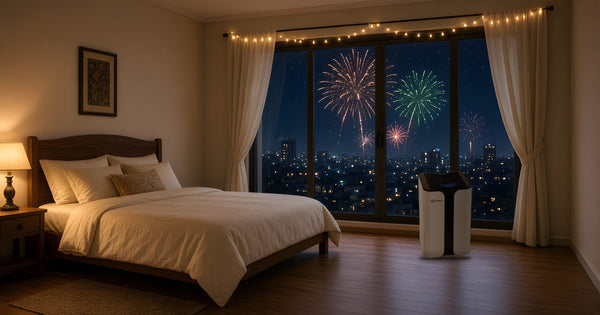
 The Airnest Core, our room purifier with an H13 HEPA filter, in a small bedroom.
Here is what our product pages on airnesthomes.com state today. For any figure not shown here, such as the Core's CADR, power draw or replacement filter price, check the Core product page or ask our support team.
| Airnest Core | Airnest Aura | |
|---|---|---|
| Best for | Bedrooms, nurseries, study rooms | Larger bedrooms and living rooms |
| Filtration | Pre-filter + H13 HEPA + activated carbon | Pre-filter + H13 HEPA + activated carbon |
| Filter efficiency | 99.95% filtration | 99.95% filtration |
| CADR (as listed) | See product page or ask support | — |
| Room size (as listed) | Up to 250 sq ft | Up to 390 sq ft |
| Noise | 24 dB (sleep), 40 dB (medium), 60 dB (high), as listed | 22 dB (low) to 48 dB (high), as listed |
| Fan speeds and timers | 3 speeds; 2 / 4 / 8-hour timer | 3 speeds + Auto Mode; 2 / 6 / 12-hour timer |
| Display | Touch panel, no app or Wi-Fi | Live PM2.5 display, Auto Mode |
| Filter life | Combined filter every 6–12 months | Combined filter every 6–12 months; reminder at about 1,440 hours |
| Price | See the Core product page linked above | See the Aura product page for the current price |
| Warranty | 12-month service warranty | 12-month service warranty |
Sources: the Airnest Core, Airnest Aura and Aura replacement filter product pages on airnesthomes.com (linked in this section).
Running costs: we don't quote filter or electricity costs here. Use the formulas in section 3 with the current filter price on each product page (the Aura replacement filter page lists the Aura's), or ask our support team for the figures.
Which to choose:
- For a 120–200 sq ft bedroom, choose the Core. It is our room purifier, with an H13 HEPA filter (99.95%), coverage up to 250 sq ft, a 24 dB sleep mode and a switchable night light.
- For a larger bedroom or living room up to 390 sq ft, choose the Aura. It uses the same H13 HEPA filter (99.95%) as the Core and adds a live PM2.5 readout and Auto Mode.
- Both include aromatherapy. It adds scent only. Fragrance doesn't clean the air; the filters do that.
Buying from us: every Airnest purifier has a 12-month service warranty and 7-day returns. Every model is in stock, with no pre-orders.
Placement tips for a bedroom purifier
- Close doors and windows while it runs. MoHFW advises keeping them shut in the morning and late evening on poor-AQI days, and ventilating if needed between 12 pm and 4 pm (>NCDC/MoHFW Health Advisory).
- Give it space. Keep it away from walls and curtains so air can flow in and out.
- Run it before bed. Switch it on an hour before you sleep, then drop to sleep mode.
- One right-sized purifier per room beats one small unit trying to clean the whole flat.
- Clean the pre-filter every few weeks, as both product pages advise, so airflow stays strong.
Not sure how bad the air is outside? Our explainer on what Delhi's AQI levels mean for your home explains Delhi's AQI levels and when to open windows. For room-by-room advice, read our air purifier buying guide for Indian homes.
Frequently asked questions
Which is the best air purifier under 5000 in India?
There's no single best. Choose one whose CADR fits your room, with a stated filter class, published filter prices, noise figures for every speed and no intentional ozone. Use the checklist above to compare.
What CADR do I need for a bedroom?
Using the US EPA chart, about 78 cfm for 120 sq ft and 130 cfm for 200 sq ft, assuming an 8-foot ceiling. More is better on severe-AQI days.
Is a desktop air purifier enough for a small room?
Only if its CADR matches the room. Many compact units have too little CADR for a whole Delhi bedroom in winter, so check the published figure against the EPA sizing numbers above before relying on one.
Does a HEPA filter purifier under 5000 really have HEPA?
Check the label. A stated class like H13 is more meaningful than "True HEPA". Products marketed as "HEPA-type" or "HEPA-like" don't meet the HEPA standard.
How loud should a bedroom air purifier be?
WHO recommends under 30 dB(A) in bedrooms at night. Look for a sleep mode below that level, and check the noise at the speed you'll actually use.
How much do filters cost per year?
Multiply the replacement filter price by how many you'll need a year. Both Airnest purifiers use a combined filter changed every 6–12 months; check the current filter price on the product page or ask our support team.
Does aromatherapy in an air purifier clean the air?
No. It only adds scent. The filters do the cleaning.
Sources
- US EPA, Guide to Air Cleaners in the Home (CADR sizing chart, smoke CADR, ozone): https://www.epa.gov/indoor-air-quality-iaq/guide-air-cleaners-home
- WHO Regional Office for Europe, Noise fact sheet (30 dB(A) in bedrooms): https://www.who.int/europe/news-room/fact-sheets/item/noise
- Wikipedia, "HEPA" (EN 1822 / ISO 29463 classes; "True HEPA" and "HEPA-type" marketing terms): https://en.wikipedia.org/wiki/HEPA
- NCDC / MoHFW, NPCCHH Health Advisory on Air Pollution (2022): https://ncdc.mohfw.gov.in/uploads/pdf/air4.pdf
- Airnest Core product page (linked in the comparison section above)
- Airnest Aura product page (linked in the comparison table above)
- Airnest Aura replacement filter page (linked under running costs above)
Airnest air purifiers
 Airnest CoreH13 True HEPA, 99.95% · For rooms up to 250 sq ft · 12-month warranty₹3,699
 Airnest AuraH13 True HEPA, 99.95% · For rooms up to 390 sq ft · 2/6/12 h timer · 12-month warranty₹4,299
Free shipping ₹4,999+ (₹399 below) · 7-day returns (faulty items free; change-of-mind returns at your cost) · Prepaid orders