
Your cart is currently empty!.
You may check out all the available products and buy some in the shop.
Continue Shopping
Three out of four air purifiers sold in India under ₹10,000 don’t use True HEPA H13. They use “HEPA-type,” “HEPA-class,” or “HEPA-grade” filters that capture only 85–95% of fine particles. For India’s PM2.5 levels, that gap matters more than any other spec on the box.
If you’ve spent a weekend scrolling through Amazon listings, Flipkart price drops, and YouTube reviews, you already know the problem isn’t a shortage of options. It’s that nobody explains which specs actually predict whether a purifier will work in your bedroom, and which ones are marketing theatre. Most “buying guides” in this space are spec dumps followed by an affiliate link.
This guide is different. By the end of it, you’ll have a five-step decision framework that works on any purifier (including ones we don’t sell), a clear understanding of the four specs that matter, an honest list of features that aren’t worth paying for, and a pre-purchase checklist you can use the moment you open a product page.
If you already know what you need and just want the model picks, skip ahead to our best air purifier in India 2026 comparison. If you want to understand how to choose, read on.
This is the entire process. Five questions, in order. Get all five right and you cannot buy a bad purifier for your home.
The rest of this guide explains each step in detail.
Forget the 30-item spec sheet on the product page. Four numbers decide whether a purifier will work in your home. Everything else is either redundant or marketing.
Definition: CADR is the volume of filtered air a purifier delivers per hour, measured in m³/h (cubic metres per hour). A higher CADR means the purifier cleans more air, faster. For Indian homes, you need a CADR that lets the air in your room cycle through the filter at least five times every hour.
CADR is the only performance number that matters because it’s measured the same way across brands. “Coverage area” claims are not. A brand can claim “covers 600 sq. ft.” with a 200 m³/h CADR by lowering their air-change rate to 2 ACH (essentially useless during cooking or smog). Match CADR to your room directly and you bypass the marketing entirely.
A simple rule for Indian rooms at standard 10 ft ceiling height: multiply room square footage by 0.85 to get the minimum CADR you need for 5 ACH. So a 200 sq. ft. bedroom needs at least 170 m³/h. We’ve published the full table below.
Definition: HEPA stands for High-Efficiency Particulate Air filter. True HEPA filters are graded H11 through H14 by capture efficiency at 0.3 microns. H11 captures 95%, H12 captures 99.5%, and H13 captures 99.95% of particles at that size. “HEPA-type,” “HEPA-class,” and “HEPA-grade” are not True HEPA and have no standardised test requirement.
Here’s why H13 matters specifically in India: PM2.5 particles are 2.5 microns and smaller, but the most dangerous fraction is around 0.3 microns, small enough to enter the bloodstream through the lungs. At AQI 300 (a normal Delhi morning in November), the difference between an H11 filter (95% capture) and an H13 filter (99.95% capture) is the difference between 15 μg/m³ and 0.75 μg/m³ of PM2.5 reaching your air. That’s a 20x improvement, not a 5% improvement.
If the product page doesn’t say “H13” explicitly, assume the filter is H11 or lower. Brands that ship H13 advertise it loudly. Brands that don’t, don’t.
This is the spec most buyers ignore until the third night. Then they switch the purifier off and never turn it back on. An off purifier cleans nothing, no matter how good the filter is.
For a bedroom, look for ≤30 dB on sleep mode or the lowest fan speed. That’s quieter than a refrigerator (40 dB) and roughly equivalent to a whisper. For comparison, the Air Nest Core runs at 24 dB on sleep mode and the Air Nest Aura at 22 dB, both engineered for the room being the deciding factor.
“Whisper-quiet” and “ultra-silent” mean nothing without a dB number. Always ask.
The pricing trick in this category is to undercut on the purifier and recover the margin on filters. A ₹3,500 purifier with ₹2,500 filters needing replacement every six months costs more over three years than a ₹4,999 purifier with ₹1,200 annual filters.
Before you buy, check three numbers:
If the brand doesn’t publish filter pricing on their product page, assume it’s because the number isn’t flattering. Make them tell you before you buy.
This is the section every other buying guide skips because it costs them affiliate commissions. We’re including it because the brand voice we write to expects us to.
Negative ion generators are oversold in this category. They produce a faint freshness but do not meaningfully add to particle removal beyond what a True HEPA filter already achieves. If a purifier has one, fine. If you’re paying ₹3,000 extra for it, no.
A UV-C lamp inside a purifier chamber sounds compelling. In practice, the air contact time as it moves past the lamp at high CADR is too short to deliver meaningful germicidal effect. UV-C makes sense in fixed-position HVAC sterilisation systems, not in 30-second air passes through a consumer purifier.
App control matters if you genuinely want to schedule on/off cycles, monitor air quality remotely, or integrate with a smart home system. For most Indian buyers running the purifier in one bedroom on auto mode, it’s a feature you’ll use twice and never again. Touch controls and a real-time PM2.5 display on the device do the same job without locking you into one brand’s app ecosystem.
A few premium brands tie filter replacement to proprietary apps with subscription nudges. Read the fine print. A purifier should outlive its app.
Most CADR charts you’ll find online assume 400 sq. ft. American living rooms with 9 ft ceilings. Real Indian bedrooms are 120–280 sq. ft. with 10 ft ceilings. Here’s the table you actually need:
| Room Size | Minimum CADR (3 ACH) | Recommended CADR (5 ACH) | Typical Indian Use Case |
|---|---|---|---|
| Up to 150 sq. ft. | 75 m³/h | 130 m³/h | Small bedroom, kid’s room, study |
| 150–250 sq. ft. | 130 m³/h | 210 m³/h | Master bedroom, 1RK, nursery |
| 250–400 sq. ft. | 210 m³/h | 340 m³/h | 1BHK living room, large bedroom |
| 400–600 sq. ft. | 340 m³/h | 510 m³/h | 2BHK living + dining, studio |
A few practical notes. If anyone in the house has asthma, allergies, or respiratory issues, size up to 6 ACH (multiply room sq. ft. by 1.0). If you live within 500 metres of a busy main road or active construction, size up similarly. And resist the urge to “future-proof” with a 600 m³/h monster in a 150 sq. ft. bedroom, it’ll be too loud on every setting except sleep mode, and you’ll pay double for filter replacements.
If you’d like to dig deeper into the math, our CADR room size calculator guide walks through the formula and edge cases.
A worked example explains this better than a formula.
Consider two purifiers a buyer in Noida might compare in early November, the week before Diwali. Purifier A is ₹3,499, marketed as “HEPA filtration,” with replacement filters at ₹2,200 every six months. Purifier B is ₹4,999, H13 True HEPA, with ₹1,200 annual filters. Both run roughly 12 hours a day, October through February.
Year one, Purifier A looks cheaper: ₹3,499 + (₹2,200 × 2) = ₹7,899. Purifier B is ₹4,999 + ₹1,200 = ₹6,199. By the end of year one, the “cheaper” purifier is already ₹1,700 more expensive, and that’s before factoring in that it’s only capturing ~90% of PM2.5 to begin with.
Run that out five years:
Add roughly ₹1,200/year in electricity for either purifier running 12 hours a day at ₹7/kWh (most purifiers under ₹10,000 draw 20–35W), and the gap holds. You’ll pay ₹14,500 more over five years for the purifier that filters worse.
The fix is simple: at the product page, look up filter price and lifespan, calculate the five-year cost, and decide. Sticker price is a starting number, not a deciding one. Our standalone breakdown of air purifier total cost of ownership in India covers brand-by-brand math if you want to compare specific models.
Once you’ve nailed the four specs, the last decision is matching to your specific situation. Use this as a decision tree.
A pre-filter for hair and dander is non-negotiable. So is an activated carbon layer for ammonia-based pet odours. Look for purifiers that specifically list pet-optimised filtration. Cleaning the pre-filter weekly extends HEPA filter life significantly in pet households.
Tadka, frying mustard seeds, and tempering can push kitchen PM2.5 above 200 μg/m³ in minutes. Place a purifier in the living room adjacent to the kitchen (not the kitchen itself, heat and steam shorten filter life). A high-CADR purifier with strong activated carbon handles the VOCs and particles that drift out. Run it for two hours after cooking, not just during.
Smog season runs October through February. Plan for the purifier to run 16–20 hours a day during this window. Size CADR for 5–6 ACH minimum, and budget for one filter replacement at the end of the season, H13 filters under heavy smog conditions can clog faster than the standard 8-month lifespan.
Year-round humidity is your bigger problem. Monsoon (June–September) drives indoor humidity above 70%, ideal conditions for mould and dust mites. A purifier helps with the airborne spores and mites, but pair it with humidity control. If you’re not sure where your home sits, an AQI monitor that tracks PM2.5 and humidity tells you what you’re actually fighting.
H13 is the minimum here. So is sleep mode under 30 dB, since the purifier runs through nap and overnight cycles. Place the purifier 1–2 metres from the cot, never directly above or beside it, and clean the pre-filter every two weeks during the first year (more dust gets disturbed in nurseries than most rooms).
Size up to 6 ACH. Add an activated carbon layer for indoor VOCs (paint, new furniture, cleaning products) that can be allergy triggers. Auto mode with a real-time PM2.5 sensor is genuinely useful here, the purifier ramps up before symptoms do.
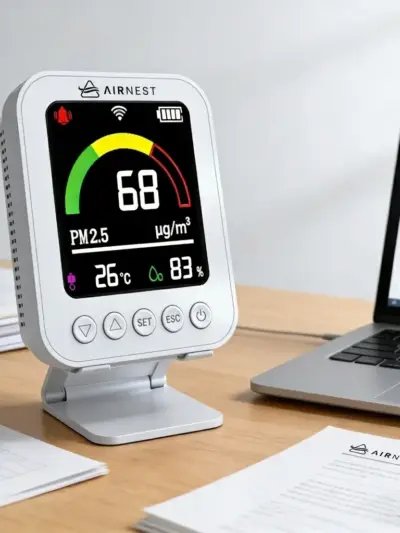
This part of the guide isn’t standard. We’re including it because we’d rather you spend ₹4,499 on a Smart AQI Monitor and learn what’s actually in your air than spend ₹15,000 on a purifier that solves the wrong problem.
Don’t buy a purifier if your problem is dry air, not dirty air. Dry winter air feels uncomfortable in the throat and on the skin. A humidifier fixes that. A purifier doesn’t. The two solve different problems and a confused buyer often spends on the wrong one.
Don’t buy a purifier if your AQI is genuinely low year-round. Some Tier 2 cities and rural areas in India have outdoor AQI under 50 for most of the year. If you’re one of them, an AQI monitor will confirm it, and you might find that ventilation and good cooking exhaust solves what little indoor problem you have. Honest answer.
Don’t buy a purifier if your indoor problem is mostly mould or humidity. A purifier captures airborne mould spores, but the underlying mould growth needs source control, a dehumidifier, better ventilation, or fixing the damp wall.
Don’t buy a purifier without measuring first. If you don’t know your baseline PM2.5, you can’t tell whether the purifier is working. Start with measurement. Then act.
For most Indian urban homes, the answer is still yes, buy the purifier. But it should be a considered yes, not a defaulted one.
Before you click “buy,” confirm all of these:
If you can tick all eight, you’re buying with full information. Most Indian buyers tick three.
Four specs matter: CADR (matched to room size for 5 air changes per hour), H13 True HEPA grade (not “HEPA-type”), sleep-mode noise under 30 dB for bedrooms, and filter replacement cost over the next five years. Everything else is secondary.
For most urban Indian homes, yes. The WHO estimates indoor air can be 2–5x more polluted than outdoor air, and Indian metros face seasonal smog, cooking PM2.5 spikes, and year-round VOC accumulation. A bedroom with a True HEPA purifier running overnight typically shows PM2.5 readings under 10 μg/m³, compared to 50–80 μg/m³ in unprotected indoor air. The health math is straightforward.
CADR (Clean Air Delivery Rate) measures the volume of filtered air a purifier delivers per hour, expressed in m³/h. To match CADR to your room, multiply room square footage by 0.85 for the minimum needed to achieve 5 air changes per hour at standard Indian ceiling height. A 200 sq. ft. bedroom needs about 170 m³/h.
Yes, for any home where PM2.5 is the primary concern (which is most of urban India). H13 captures 99.95% of particles at 0.3 microns. H11 captures 95%. At Delhi’s typical winter AQI 300, that gap means roughly 20x more particles in your air. The cost difference between an H11 and H13 purifier is usually under ₹2,000 and worth every rupee.
Real-time PM2.5 sensing with auto mode is genuinely useful, the purifier responds to spikes (cooking, smog, dust) without you managing it. App control matters less than buyers expect. Most users open the app twice in the first week and never again. Spend on the sensor; don’t overpay for the app.
A typical Indian bedroom purifier draws 20–35W on low and 50–70W on high. Running 12 hours a day on auto mode (mostly low), that’s roughly 0.3–0.5 units per day, or ₹60–₹100 per month at ₹7/kWh. Less than most people spend on chai.
Yes. Purifiers are designed for continuous operation. Most Indian buyers run them 8–16 hours a day, mainly through the evening and overnight. The energy cost is low enough that there’s no meaningful trade-off.
Some are, many aren’t. The deciding factors are HEPA grade (H13 or not) and filter replacement cost. A ₹4,999 purifier with verified H13 and ₹1,200 annual filters is a better buy than a ₹3,500 purifier with “HEPA-type” filters at ₹2,200 every six months. The under-₹5,000 bracket has genuine options now if you know how to evaluate them. Our best air purifier under ₹5,000 in India breakdown covers the picks worth considering.
Three rules. Keep 30–50 cm of clear space on all sides for proper intake and output. Place it roughly 1–2 metres from where you sit or sleep, never directly behind furniture. And avoid corners, air doesn’t circulate well into corners and you’ll halve the purifier’s effective performance.
The air purifier market in India is loud, overpriced at the top, and confusing in the middle. But the buying decision is actually simple once you separate the four specs that matter from the noise:
Run those four checks on any purifier you’re considering and you’ll filter out 90% of the bad buys before you reach checkout. Add the use-case decision tree above and you’ll narrow the remaining options to two or three genuinely sensible choices for your specific home.
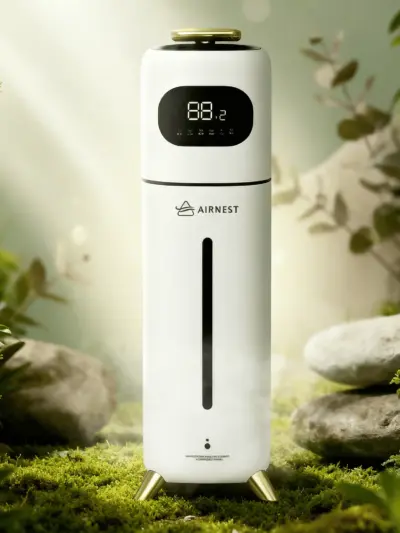
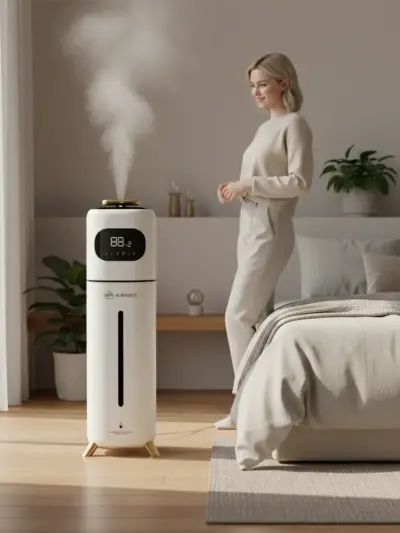
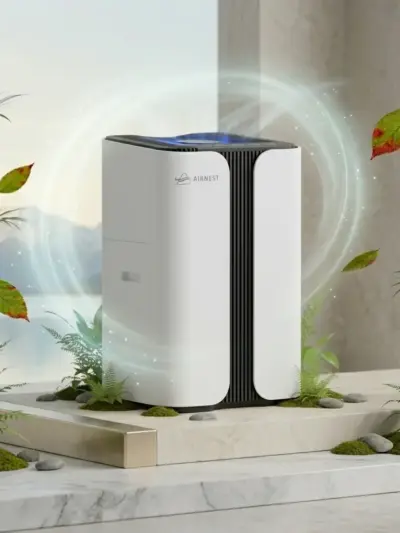
We make two purifiers, the Air Nest Core for full-bedroom coverage and the Air Nest Aura for desks and personal spaces, both at ₹4,999, and we built this guide so it works on every other purifier too, not just ours. Buy what your home actually needs. Buy it for the next five years, not the next five minutes.
If you’re ready to compare specific models with the framework above, our best air purifier in India 2026 guide is the natural next step. If you want to understand the technology side more deeply first, the HEPA filtration guide for India explains H11 vs H13 vs H14 in plain English.
Clean air shouldn’t be a luxury. Once you know what to look for, it isn’t.
Pre-Order
Pre-Order