
Your cart is currently empty!.
You may check out all the available products and buy some in the shop.
Continue Shopping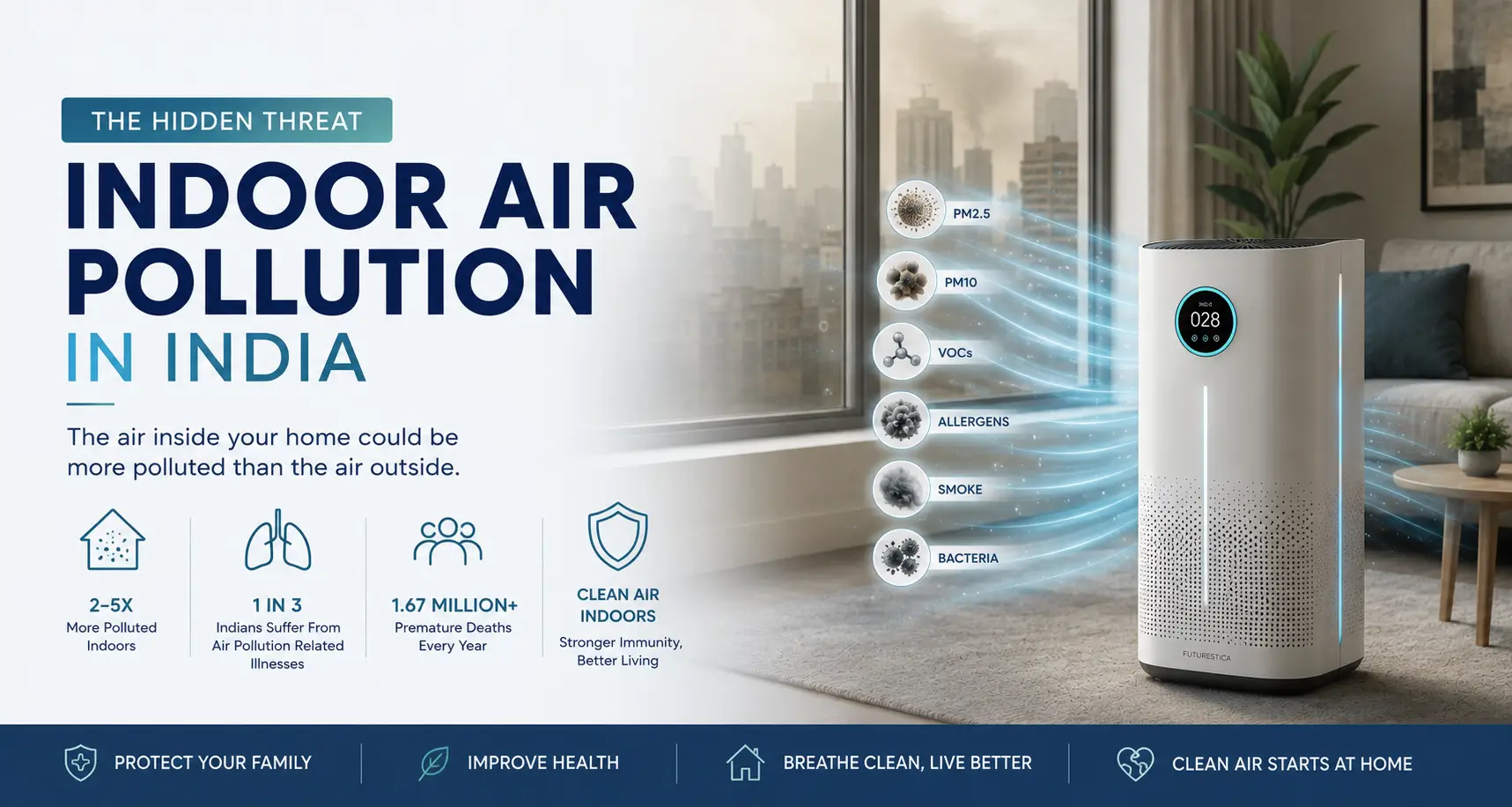
The night your AC bedroom hit 1,400 ppm of CO₂, your nose didn’t notice. Your brain did. Indoor air pollution in India isn’t just the PM2.5 we read about in winter headlines. It’s cooking VOCs from a Tuesday tadka, sealed-room CO₂ accumulating overnight, monsoon mould in a sixth-floor bathroom, and Diwali smoke that lingers for a week. All of it stacks into the 90% of your week you spend inside four walls.
Most Indian conversations about air pollution start outside, with diesel exhaust, stubble burning, and AQI readings on weather apps. But the air that affects your health most directly is the air you’ve been breathing for the last 18 hours: the air inside your home. The World Health Organization estimates that indoor air can be 2–5 times more polluted than outdoor air. In Indian cities, where tight construction, gas-stove cooking, seasonal smog infiltration, and synthetic furnishings layer on top of each other, that number often sits closer to the higher end.
This guide is the comprehensive answer to a question most Indian homeowners haven’t fully asked yet. What’s actually in the air inside your home? Where does it come from? What does each pollutant do to a body that breathes it for years? And, most importantly, what genuinely works to reduce it? You’ll find specific data from CPCB, WHO, and TERI, a layered intervention framework that works for any Indian home, and a seasonal calendar so you know what to act on and when.
Indoor air pollution is the presence of harmful particles, gases, or biological agents inside an enclosed space. Outdoor pollution gets most of the attention because it’s measurable on a public dashboard. Indoor pollution is harder to see, more constant, and almost entirely under your control. There are three categories, and they require different solutions.
PM2.5 is particulate matter smaller than 2.5 microns. PM10 is particles smaller than 10 microns. Both are measured in micrograms per cubic metre (μg/m³). The distinction matters because PM2.5 is small enough to bypass nasal filters, enter the lungs, and pass into the bloodstream. PM10 mostly stops in the upper airway and causes irritation rather than systemic illness.
PM2.5 is the dominant Indian indoor air problem. It comes from cooking smoke, candle and incense use, infiltration of outdoor smog, and resuspension of settled dust. The WHO 24-hour PM2.5 safe limit is 15 μg/m³. Indian metro homes in November regularly exceed 80 μg/m³ indoors, and kitchens during cooking can spike past 200.
Gas-phase pollutants don’t appear on AQI dashboards but they’re often the more dangerous fraction of indoor air. The big four in Indian homes:
A True HEPA filter doesn’t catch any of these. The activated carbon layer in a 3-stage purifier does.
These are airborne organic particles. Mould spores release during monsoon humidity above 70%. Dust mites thrive in mattresses, pillows, and curtains, and their faecal proteins are a leading trigger for allergic asthma in India. Pet dander stays airborne for hours and is a common allergen for sensitive individuals. Bacteria and viral particles also fall in this category, particularly relevant in shared family spaces.
HEPA filtration handles all four. Humidity control prevents mould from becoming a problem in the first place.
Knowing what indoor air pollution is in the abstract is less useful than knowing where it specifically comes from in an Indian home. Six sources dominate, and each requires a different intervention.
This is the single largest controllable source of indoor PM2.5 in Indian households. Every time you heat oil, fry onions, or temper a tadka, the combination of combustion gases and food aerosols pushes kitchen PM2.5 well past 200 μg/m³. Research from TERI and IIT Delhi has documented kitchen PM2.5 spikes above 400 μg/m³ during heavy frying or grilling.
In a typical Indian apartment, the kitchen connects to the living room and bedrooms through doorways and shared HVAC paths. Cooking PM2.5 doesn’t stay in the kitchen. Without active filtration or strong exhaust ventilation, it can remain elevated for 90–120 minutes after cooking ends. Gas stoves also release NO₂ and CO during combustion, which standard PM2.5 filtration doesn’t capture.
Between October and February, North Indian cities experience some of the worst air quality on Earth. CPCB AQI data shows Delhi NCR regularly crossing AQI 350–450 during this window. Even in cities like Mumbai and Pune that don’t get the same headlines, winter temperature inversions trap pollutants closer to ground level and indoor PM2.5 climbs as a result.
Outdoor air infiltrates indoor space through gaps in window frames, under doors, and through ventilation ducts even when everything is closed. A sealed AC apartment reduces this exchange but does not eliminate it. Most Indian metro homes during smog season run indoor PM2.5 between 40 and 100 μg/m³ without active filtration. That’s well above the WHO 24-hour safe limit.
In any Indian metro, construction is constant. Concrete dust, cement mixing, drilling, and road work generate fine silica particles that drift across neighbourhoods, settle on surfaces, and resuspend when disturbed. If your flat sits within 500 metres of an active site, your indoor PM2.5 baseline is measurably higher than a similar flat a kilometre away.
This source is invisible because the particles don’t carry a smell. They show up only when you measure or when you notice dust on a glass shelf the day after cleaning.
New furniture, especially MDF and plywood with formaldehyde-based adhesives, off-gasses for months after manufacture. Paints, varnishes, polishes, and many cleaning sprays release VOCs. Air fresheners and incense, common in Indian homes, add their own mix of chemical compounds that standard particulate filters cannot capture.
The smell of a freshly painted room or new furniture isn’t just a smell. It’s a chemical mix that includes formaldehyde, benzene, and toluene at concentrations that can exceed safe exposure limits for several weeks. The honest answer here is source control (low-VOC paint, ventilation during off-gassing, time before children sleep in a freshly painted room) plus an activated carbon layer in any room purifier.
Indian monsoon humidity routinely crosses 75% in coastal cities and many inland areas. That’s the threshold above which mould growth accelerates in soft furnishings, mattresses, wall corners, and bathroom ceilings. Dust mites thrive in the same humidity range, and their populations explode during monsoon and remain elevated through October.
Pet households add dander to the mix. Cat and dog dander particles are typically 2–5 microns, fine enough to stay airborne for hours and small enough that ordinary household cleaning cannot eliminate them. For households with allergies, this is often the dominant indoor pollution problem.
This is the most under-discussed indoor air problem in modern India. As air-conditioning has become standard in urban homes, families increasingly sleep in sealed bedrooms with no fresh-air exchange for 7–9 hours overnight. Two adults sharing a 150 sq. ft. bedroom typically push CO₂ levels from a baseline of 600 ppm at lights-out to 1,400–1,800 ppm by morning.
The threshold for cognitive effects (slower decision-making, fragmented sleep, morning headaches) is around 1,000 ppm. The threshold for documented sleep-quality decline is 1,200 ppm. Most Indian sealed-AC bedrooms exceed both, and the family wakes up assuming the morning fog is just “tiredness.”
CO₂ is not a pollutant in the conventional toxic sense. But at 1,500+ ppm, sustained for years, it materially affects sleep and waking cognition. The solution is either ventilation (window cracked, exhaust fan), measurement (a portable PM2.5 and CO₂ monitor reads both alongside humidity and temperature), or both. A standard air purifier does not address CO₂ at all.
Abstract framing is one thing. Specific numbers are another. Here is what Indian research has actually documented.
The WHO PM2.5 24-hour guideline sets the safe limit at 15 μg/m³ averaged over a day. India’s national ambient air quality standard is 60 μg/m³ over 24 hours, which is four times the WHO recommendation. Most Indian metros exceed even the domestic standard for 4–6 months of the year.
Inside Indian homes, IIT Delhi and TERI studies have documented:
For context, the US Environmental Protection Agency classifies PM2.5 above 35.4 μg/m³ as “unhealthy for sensitive groups” and above 55.5 as “unhealthy for everyone.” Most Indian urban homes sit above the first threshold for a significant portion of the year, and many sit above the second during smog season.
Indoor air pollution is a chronic exposure problem. The damage isn’t visible after a single bad day. It accumulates over months and years, and the relationship between exposure and disease is well-established in the medical literature.
Within hours of exposure: eye and throat irritation, headache, sneezing, fatigue, exacerbation of existing asthma or allergies. Cooking-related NO₂ exposure can trigger an asthma attack within minutes in sensitive individuals. CO₂ levels above 1,000 ppm cause measurable cognitive slowdown within a couple of hours.
Sustained PM2.5 exposure is linked to reduced lung function, chronic bronchitis, increased cardiovascular disease risk, and elevated lifetime risk of lung cancer. The WHO estimates that household air pollution contributes to roughly 3.2 million premature deaths globally each year, with a disproportionate share in South Asia.
For children specifically, exposure during the lung development window (birth through adolescence) is associated with permanently reduced lung capacity in adulthood. Indian research from AIIMS and other institutions has documented measurable reductions in school-age lung capacity in high-PM2.5 cities compared with cleaner regions.
Five groups face disproportionate risk and should prioritise their indoor air interventions:
For households with anyone in these groups, our air purifier guide for allergies and asthma in India covers the specific filtration approach required.
Most articles on this topic recommend one solution: buy an air purifier. That’s incomplete. Indoor air quality is a layered problem, and the right answer depends on which pollutant you’re actually fighting. Here is the five-step framework that works for any Indian home.
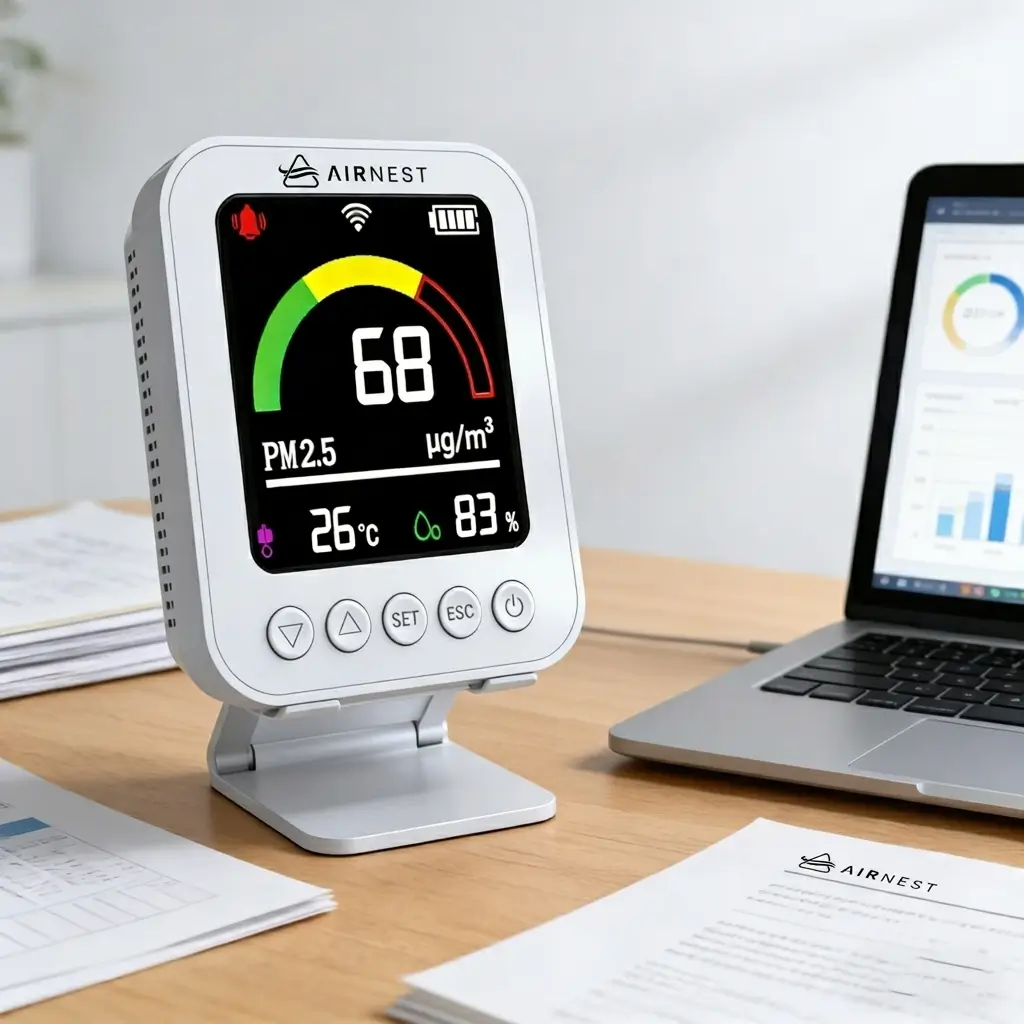
You cannot fix what you cannot measure. The single highest-leverage first action for most Indian households is to find out what’s actually in their air. The Airnest Smart AQI Monitor measures PM2.5, CO₂, temperature, and humidity in real time, runs on a portable battery, and shows you which rooms are clean and which aren’t.
Three hours with a monitor will tell you more than three months of guessing. You’ll see which kitchen activity actually spikes PM2.5, whether your bedroom CO₂ crosses 1,000 ppm overnight, and whether your monsoon humidity is in the mould-friendly range. From that baseline, you can act with precision.
See the air you breathe. Make better decisions for the people who share it.
Removing the source is always cheaper and more effective than filtering after the fact. Practical interventions:
For PM2.5 and biological pollutants that can’t be eliminated at source, a properly specified air purifier is the most direct solution. Three things matter:
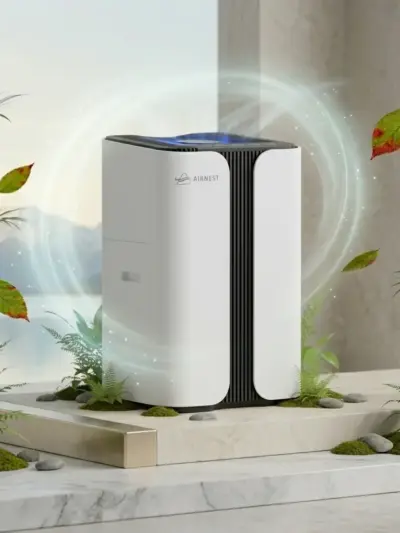
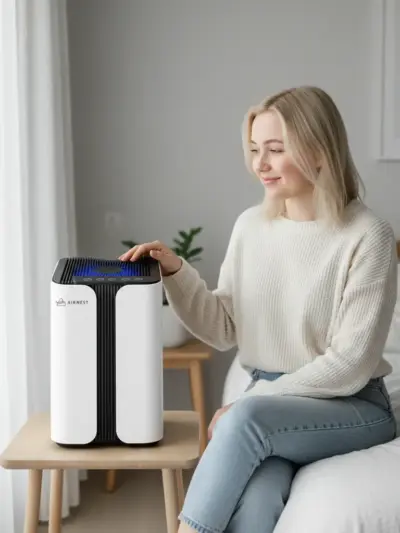
The Air Nest Core delivers all three at ₹4,999, with 5 ACH coverage in a 219 sq. ft. bedroom. The Air Nest Aura is a personal-space purifier for desks and nightstands, also at ₹4,999. If you’re ready to compare specific models, our air purifier buying guide for India walks through the 5-step decision framework.
Indian air has two opposite problems. Monsoon humidity (75% and above) drives mould and dust mites. AC and winter heating dry the air below 30% relative humidity, which irritates respiratory systems and dries skin. The healthy target for indoor humidity year-round is 40–60%.
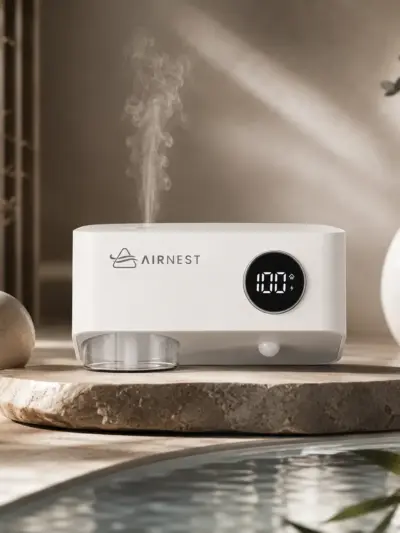
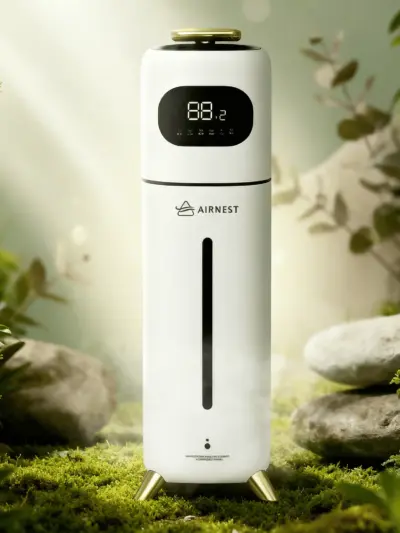
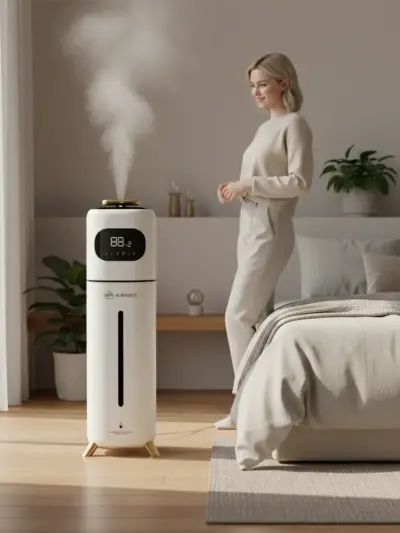
A dehumidifier handles the high end. A humidifier with UV sterilisation and humidity-control feedback handles the low end. The Airnest Ultrasonic Humidifier holds an 8L tank, sterilises mist with UV before output, and auto-maintains 45–65% relative humidity. For winter and AC-heavy households, this matters more than most buyers realise.
The simplest indoor air rule: when outdoor AQI is low (below 100), ventilate aggressively. When outdoor AQI is high (above 150), seal and filter. The mistake is doing the opposite, opening windows during a smog event to “freshen the air,” or sealing the house all summer when outdoor air is actually cleaner than what’s inside.
Watch the AQI dashboard. Match your behaviour to outdoor conditions, not to habit.
Before you buy a purifier or change anything, the cheapest and most useful investment you can make is a monitor. Indian buyers tend to skip this step because it doesn’t feel like a “solution.” It is the solution that makes every subsequent solution work.
A good indoor air quality monitor should measure four things:
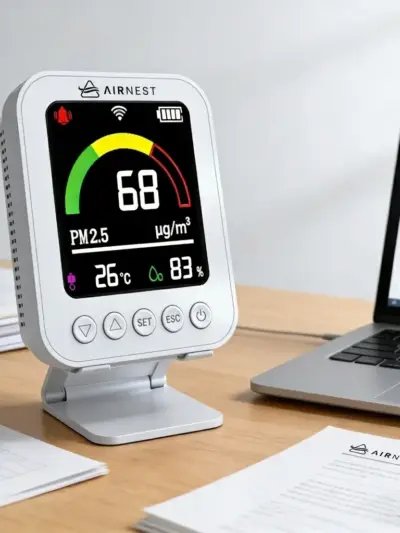
The real-time AQI tracker from Airnest does all four at ₹4,499. It’s portable on a 3,200 mAh battery, so you can carry it from kitchen to bedroom to nursery over a couple of days and build a picture of your home’s actual baseline. The 85 dB audible alarm fires when PM2.5 or CO₂ crosses unsafe thresholds, which is genuinely useful overnight in a sealed bedroom.
Once you have data, every other decision in this guide becomes precise rather than guessed.
There’s a hierarchy of standards relevant to Indian indoor air quality, and the gaps between them tell you something useful.
WHO Global Air Quality Guidelines (2021) set the most conservative thresholds. PM2.5 24-hour guideline: 15 μg/m³. Annual guideline: 5 μg/m³. These are health-based, not feasibility-based.
Indian National Ambient Air Quality Standards (set by CPCB) are looser. PM2.5 24-hour standard: 60 μg/m³. Annual standard: 40 μg/m³. These reflect what India considers achievable rather than what is medically ideal.
IS 17601 from the Bureau of Indian Standards is the consumer air purifier standard published in 2021. It sets testing protocols but does not specify a minimum HEPA grade for sale, which is the loophole that lets “HEPA-type” filters be marketed as HEPA.
CPCB National Air Quality Index is the public AQI dashboard you see on weather apps. It uses the standard 0–500 scale. Below 50 is good, 51–100 satisfactory, 101–200 moderate (sensitive groups should take care), 201–300 poor, 301–400 very poor, 401–500 severe.
The practical takeaway: WHO thresholds are the health target, Indian standards are the regulatory floor, and the AQI dashboard tells you when to seal and filter. Use all three.
India doesn’t have one indoor air problem. It has four, and they rotate through the year. Knowing which one is in season tells you what to prioritise.
The big one. North Indian metros (Delhi, NCR, Lucknow, Kanpur, Patna) experience outdoor AQI 200–500 for four to five months. Indoor PM2.5 climbs in lockstep through infiltration. Diwali compounds it with a localised PM2.5 surge that can last 5–7 days.
What to do: run air purifiers continuously, ideally on auto mode. Seal windows. Run them through Diwali week regardless of how the air smells. Consider sizing CADR to 6 ACH using the 1.7 multiplier rather than the 5 ACH baseline.
Humidity becomes the dominant problem. Indoor humidity above 70% accelerates mould growth on walls and ceilings, populates dust mites in bedding and curtains, and triggers allergic rhinitis in sensitive individuals. PM2.5 actually drops during monsoon as rain scrubs the outdoor air, but biological pollutants surge.
What to do: keep indoor humidity below 60%. Use a dehumidifier or AC dry mode. Wash and air bedding more frequently. Check bathroom and kitchen ceilings monthly for early mould.
Dry dust season. Outdoor construction continues, water sprinkling reduces, and fine silica particles drift further. AC use begins, sealing bedrooms and starting the CO₂ accumulation pattern. PM2.5 outdoor is typically lower than winter but still well above WHO guidelines.
What to do: dust surfaces more often (resuspension matters). Run AC efficiently but crack a window for 10 minutes morning and evening to ventilate. Watch indoor PM2.5 baseline; summer cooking PM2.5 spikes are still significant.
Diwali in particular spikes PM2.5 indoors and outdoors for a week. Cracker smoke, woodfire-cooked sweets, incense, and oil lamps all add to the load. Holi mornings can be PM2.5-heavy in cities where larger gatherings burn refuse afterwards.
What to do: run purifiers continuously across festival week. Keep windows closed during peak hours. Consider stocking up on filter replacements before festival season, not during.
Often, yes. The WHO estimates that indoor air can be 2–5 times more polluted than outdoor air. In Indian homes, where cooking emissions, off-gassing furniture, sealed AC bedrooms, and biological pollutants stack on top of each other, the indoor reading can be the higher one for most of the year.
Six dominant sources: cooking on gas stoves (PM2.5, NO₂, CO), seasonal smog infiltration from outdoor air, construction dust, VOCs from new furniture and paint, biological pollutants (mould, dust mites, pet dander), and CO₂ accumulation in sealed AC bedrooms.
It depends on outdoor AQI. When outdoor AQI is below 100, ventilation significantly improves indoor air. When AQI exceeds 150, opening windows actively worsens indoor air. Use active filtration during high-AQI periods and ventilate during low-AQI windows.
A portable indoor air quality monitor that reads PM2.5, CO₂, temperature, and humidity is the cheapest way. The Airnest Smart AQI Monitor measures all four at ₹4,499. Three hours of measurement across kitchen, bedroom, and living room will tell you more than months of guessing.
The research on indoor plants as air purifiers is widely overstated. While some plants absorb trace VOCs, the scale required for meaningful impact (hundreds of plants per room) is impractical. Plants are pleasant but they are not a substitute for mechanical filtration.
Indoor PM2.5 above 35 μg/m³ is “unhealthy for sensitive groups” per US EPA classification. Above 55 is unhealthy for everyone. The WHO 24-hour safe limit is 15 μg/m³. Most Indian urban indoor air exceeds 15 for several months a year.
Likely CO₂ accumulation. A sealed AC bedroom with two adults can rise from 600 ppm at bedtime to 1,400–1,800 ppm by morning. Above 1,000 ppm causes measurable sleep quality decline. A cracked window, an exhaust fan, or even a slightly open door will dramatically reduce overnight CO₂.
Yes, significantly. Tadka, frying, grilling, and tempering can push kitchen PM2.5 above 200 μg/m³ in minutes. The PM2.5 travels into the rest of the home through doorways and shared HVAC paths. Cooking ventilation (exhaust fan or window with outward-blowing fan) reduces the spike by 60–80%.
H13 True HEPA filtration in the nursery, kept running through sleep cycles. Ultra-quiet operation matters (look for sleep mode ≤30 dB). Avoid incense, candles, and synthetic air fresheners in the room. Air new furniture in another room for 2–4 weeks before placing in the nursery. Measure baseline PM2.5 and CO₂ before assuming the room is safe.
Yes, for bedrooms during smog season and continuously in any room you spend extended time in. Modern purifiers draw 20–50W on auto mode, which means continuous operation costs roughly ₹60–₹150 per month per room at typical Indian electricity rates. The health benefit is significant; the energy cost is not.
For most urban Indian homes, yes. The WHO data on indoor air being 2–5x more polluted than outdoor air, combined with the documented health impact of sustained PM2.5 exposure, makes the case clear. The honest answer is: measure first to confirm your baseline (use an AQI monitor), then act with a properly specified purifier matched to your room.
An air purifier removes particles and gases from the air. A humidifier adds moisture. They solve different problems. Most Indian homes need both for different seasons. The purifier runs year-round; the humidifier runs primarily during AC season and dry winter months.
Clean indoor air isn’t a given in India. It’s a series of decisions, made in sequence, that adds up to a house where your family can breathe without thinking about it. Five things matter most:
Indoor air pollution in India is solvable. It requires the right interventions in the right sequence, not a single product purchase. If you’re ready to act, our air purifier buying guide, CADR room sizing formula, and True HEPA explainer are the natural next reads. For comparing specific models, our best air purifier in India 2026 guide covers the top picks across price brackets; for bedroom-specific recommendations, our best air purifier for the bedroom in India round-up walks through the picks.
The air inside your home is one of the few environmental factors you fully control. Take the data. Act on it. Your lungs will know the difference within a week.
Pre-Order
Pre-Order