
Your cart is currently empty!.
You may check out all the available products and buy some in the shop.
Continue Shopping
A “HEPA-type” filter isn’t HEPA. A 200 m³/h CADR isn’t always enough for a 200 sq. ft. room. “Coverage area” is a brand claim, not a measurement. Most air quality glossaries skip these honest details. This one doesn’t.
If you’ve shopped for an air purifier in India, watched a YouTube review on indoor air quality, or tried to make sense of an AQI dashboard, you’ve seen the vocabulary stack: CADR, AQI, ACH, H13, MPPS, VOC, AHAM, EN 1822, IS 17601, PM2.5, ppm, μg/m³. Some of these are regulated technical terms. Some are marketing claims dressed up to look technical. Knowing which is which is half the battle.
This glossary defines 40+ terms across five categories: pollutants (what’s actually in your air), measurement (how it’s quantified), filtration technology (what HEPA does and doesn’t mean), standards (the bodies that publish the rules), and product specs (what to look for on a spec sheet). Every definition is written for a featured-snippet box on Google. Every term links to the deeper Airnest article where one exists. Use the index below, or read straight through.
ACH · Activated Carbon Filter · AHAM · AHAM Verifide · Air Quality Monitor · AQI · ASHRAE · Auto Mode · BIS · CADR · CFM and m³/h · CO · CO₂ · Coverage Area · CPCB · dB · Dander · DEHS Aerosol · Dust Mites · EN 1822 · Filter Lifespan · Formaldehyde · H11–H14 HEPA Grades · HEPA · HEPA-type / class / grade · Indoor vs Outdoor Air Quality · IS 17601 · ISO 29463 · MERV · Mould Spores · MPPS · National Building Code · Negative Ion Generator · NO₂ · PM10 · PM2.5 · ppm · Pre-filter · Relative Humidity (RH) · Sleep Mode · Smog · Smoke / Dust / Pollen CADR · TERI · True HEPA · μg/m³ · ULPA · UV-C Sterilisation · VOC · WHO Air Quality Guidelines
PM2.5 is particulate matter with a diameter of 2.5 microns or smaller. It’s small enough to pass through nasal filters, enter the lungs, and cross into the bloodstream. PM2.5 is the dominant Indian indoor air pollutant, generated by cooking, smog infiltration, construction dust, and combustion.
At Delhi AQI 300 in November, outdoor PM2.5 typically runs around 200 μg/m³. The WHO 24-hour safe limit is 15 μg/m³. Indian metro homes during smog season regularly exceed 60–100 μg/m³ indoors without active filtration. For the full breakdown, see our indoor air pollution guide for India.
PM10 is particulate matter with a diameter of 10 microns or smaller. It includes PM2.5 but also larger particles like coarse dust, pollen, and mould spores. PM10 mostly stops in the upper respiratory tract and causes irritation rather than systemic illness.
PM10 spikes during construction, dry summer dust, and seasonal pollen events. While less dangerous than PM2.5, sustained PM10 exposure aggravates asthma and triggers allergic rhinitis. A True HEPA filter captures both PM10 and PM2.5 with the same media.
VOC (Volatile Organic Compound) is any carbon-based gas that evaporates at room temperature. Common indoor VOCs include formaldehyde from MDF furniture, benzene from paints, toluene from adhesives, and limonene from cleaning sprays. VOCs are gases, not particles. HEPA filtration does not capture them.
For VOC removal, you need an activated carbon layer in the purifier. Indian homes with new furniture, recent paint, or daily incense use carry elevated VOC loads. The honest interventions are source control (low-VOC choices, ventilation during off-gassing) plus a 3-stage purifier with carbon. See our Indian indoor air quality guide for the broader picture.
CO (Carbon Monoxide) is a colourless, odourless gas produced by incomplete combustion. In Indian homes, the dominant source is gas stoves used without exhaust ventilation. CO at concentrated levels causes headaches, dizziness, and at extreme exposure, fatal poisoning. It does not appear on standard AQI dashboards.
The fix is cooking ventilation: a kitchen exhaust fan, an open window during cooking, or both. CO is not captured by HEPA or activated carbon at typical residential concentrations. Detection requires a dedicated CO alarm, not a general air quality monitor.
CO₂ (Carbon dioxide) is the gas humans exhale. Above 1,000 parts per million indoors, CO₂ measurably slows cognitive function. Above 1,200 ppm, it degrades sleep quality. Sealed AC bedrooms with two adults routinely reach 1,400–1,800 ppm by morning, the under-discussed Indian indoor air problem.
CO₂ is not removed by air purifiers. The fix is ventilation: a cracked window, exhaust fan, or door left ajar. To know whether your bedroom has a CO₂ problem, you need to measure. The Airnest Smart AQI Monitor reads CO₂ alongside PM2.5, temperature, and humidity.
NO₂ (Nitrogen dioxide) is a gas produced by high-temperature combustion. In Indian homes, the primary source is gas-stove cooking; outside the home, vehicle exhaust contributes. NO₂ is a documented asthma trigger, particularly in children, and a respiratory irritant in higher concentrations.
NO₂ is captured by activated carbon filters but not by HEPA alone. Kitchens with gas stoves accumulate NO₂ during cooking; sustained exposure correlates with elevated childhood asthma rates in Indian urban research from AIIMS and other institutions.
Formaldehyde is a Group 1 carcinogen (per the WHO IARC classification) that off-gases from MDF furniture, plywood, certain adhesives, and some fabrics. Newly built or renovated Indian apartments can carry indoor formaldehyde concentrations of 0.05–0.10 mg/m³ for the first 3–6 months.
The honest interventions are time (off-gas new furniture in a ventilated room for 2–4 weeks before placing it in a bedroom), low-formaldehyde material choices when renovating, and an activated carbon filter in any room with new MDF furniture.
Dust mites are microscopic arachnids that live in mattresses, pillows, curtains, and upholstery. Their faecal proteins are a leading trigger of allergic asthma in India. Populations explode when relative humidity exceeds 70%, common during monsoon and along Indian coastlines.
Dust mites themselves are too large to be airborne, but their faecal particles (around 10–40 microns) are easily disturbed by movement and stay airborne for minutes. HEPA filtration captures them; humidity control below 60% prevents proliferation in the first place.
Mould spores are reproductive cells released by mould colonies, typically 2–10 microns in size. They become airborne in conditions above 70% relative humidity, common during Indian monsoon (June–September). Sustained exposure triggers allergic rhinitis, asthma, and in some cases more serious respiratory infections.
Mould requires a damp substrate to grow, so the long-term fix is humidity control and finding any wet wall, ceiling, or bathroom corner that supports growth. HEPA filtration captures airborne spores but doesn’t address the underlying colony. Once mould is established, source removal is essential.
Pet dander is microscopic skin flakes shed by cats, dogs, and other animals. Particles are typically 2–5 microns, fine enough to stay airborne for hours. Pet dander is one of the most common indoor allergens, responsible for asthma and rhinitis flares in roughly 10–20% of Indian urban households with pets.
True HEPA captures dander efficiently. A pre-filter handles loose hair before it reaches the HEPA stage. For households with allergic family members and pets, the right setup is continuous H13 True HEPA in the bedroom and primary living space. See our air purifier guide for the decision framework.
Smog is a visible mixture of particulate matter, nitrogen oxides, ozone, and other pollutants concentrated in the lower atmosphere. North Indian cities experience severe smog from October through February, driven by temperature inversions, vehicle exhaust, industrial emissions, and seasonal stubble burning.
During Delhi smog season, outdoor AQI regularly crosses 350–450 on the CPCB scale. Indoor PM2.5 climbs in lockstep through infiltration even with windows closed. The response is to seal and filter continuously through the season, not to ventilate.
AQI (Air Quality Index) is a 0–500 scale that converts multiple pollutant readings into a single comparable number. India’s CPCB uses the AQI scale on public dashboards. Below 50 is good; 51–100 satisfactory; 101–200 moderate; 201–300 poor; 301–400 very poor; 401–500 severe.
The Indian AQI weighs eight pollutants but is dominated by PM2.5 and PM10 in most cities. AQI 300 in Indian metros typically corresponds to PM2.5 around 150–250 μg/m³. The dashboard tells you when to seal and filter; the WHO 15 μg/m³ daily limit tells you the medical target.
ACH (Air Changes per Hour) is the number of times per hour the entire volume of air in a room cycles through a filter. ASHRAE recommends 4–5 ACH as the residential baseline. For Indian conditions, 5 ACH is the practical minimum, with 6 ACH for allergy households or smog season.
ACH is calculated from CADR and room volume: ACH = CADR ÷ Room Volume. For India’s 10 ft ceilings, a quick formula gives you the CADR you need: room sq. ft. × 1.4 for 5 ACH, or × 1.7 for 6 ACH. See our CADR room size guide for the full math.
CADR (Clean Air Delivery Rate) measures the volume of filtered air an air purifier delivers per hour, expressed in m³/h or CFM. CADR is the only performance number you can compare directly across brands because it’s measured the same way by every manufacturer certified by AHAM.
For an Indian bedroom, multiply room square footage by 1.4 to get the minimum CADR for 5 ACH at India’s typical 10 ft ceiling. A 200 sq. ft. bedroom needs about 280 m³/h. For the full breakdown including allergy adjustments and India-specific room examples, see our CADR and room size guide.
μg/m³ (micrograms per cubic metre) is the unit used to measure particulate matter concentration in air. The WHO PM2.5 24-hour guideline is 15 μg/m³. India’s national standard is 60 μg/m³. Indoor readings can be checked using a PM2.5 monitor.
For context, “moderate” indoor air is below 35 μg/m³. “Unhealthy for sensitive groups” starts at 35 μg/m³ per the US EPA. “Unhealthy for everyone” starts at 55 μg/m³. During Delhi smog season, indoor PM2.5 without filtration typically sits in the 60–100 μg/m³ range.
ppm (parts per million) is a unit used to measure gas concentration. One ppm means one molecule of the gas per million molecules of air. CO₂ is the most common ppm reading in indoor air: 400 ppm is fresh outdoor baseline, 1,000 ppm causes cognitive decline, 1,200 ppm degrades sleep quality.
The threshold matters because most Indian sealed AC bedrooms cross 1,000 ppm CO₂ within an hour of going to bed with two adults present, and reach 1,400–1,800 ppm by morning. A dedicated air quality monitor with a CO₂ sensor is the only way to know your baseline.
Relative humidity (RH) is the percentage of moisture in the air relative to the maximum it could hold at the current temperature. The healthy indoor target is 40–60%. Below 30% irritates respiratory systems and dries skin; above 70% accelerates mould growth and dust mite proliferation.
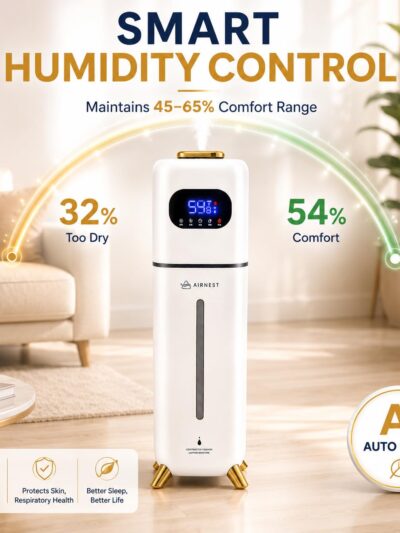
Indian air swings between extremes. Monsoon humidity hits 75–85% in coastal cities. AC and winter heating dry indoor air to 25–35%. A humidifier balances the dry end (the Airnest Ultrasonic Humidifier auto-maintains 45–65% RH); a dehumidifier or AC dry mode balances the wet end.
Indoor vs outdoor air quality refers to the difference between pollution levels inside an enclosed space and outside. The WHO estimates indoor air can be 2–5 times more polluted than outdoor air. In Indian homes, cooking emissions, off-gassing furniture, and sealed bedrooms can push indoor readings above outdoor.
The implication: relying on outdoor AQI dashboards alone is misleading. Indoor measurement (via a dedicated monitor) reveals the actual exposure pattern for the 18–22 hours a day Indians typically spend inside. See our indoor pollution sources guide.
MERV (Minimum Efficiency Reporting Value) is the ASHRAE rating system for filter efficiency, measured on a 1–16 scale. MERV is used primarily for HVAC and commercial filtration, while HEPA grades (H11–H14) are used for consumer air purifiers. A “MERV 17” claim is not the same as H13.
For consumer air purifiers in India, focus on HEPA grades rather than MERV. Brands that quote MERV ratings in residential context are often substituting a coarser scale for the True HEPA certification their product doesn’t carry.
HEPA (High-Efficiency Particulate Air) is a filtration standard originally defined by the US Department of Energy as capturing 99.97% of particles at 0.3 microns. The modern global standards are EN 1822 and ISO 29463, which use grades H11 through H14. HEPA is a measurement, not a marketing term.
A correctly certified HEPA filter has its H-grade printed on the filter itself, not just the outer box. For India’s PM2.5-heavy indoor air, H13 is the consumer ceiling. See our True HEPA vs HEPA-type explainer for the grade-system breakdown, and our complete HEPA air purifier guide for India for the broader buying decision.
True HEPA is industry shorthand for a filter that meets the original DOE specification (99.97% at 0.3 microns), broadly equivalent to H13 on the EN 1822 grade scale. The phrase is not a regulated term anywhere in India. To verify a “True HEPA” claim, look for an explicit H-grade.
The Air Nest Core and Air Nest Aura both use H13 True HEPA at ₹4,999. The grade is the regulated certification; “True HEPA” is the claim that should always be paired with it.
HEPA-type, HEPA-class, and HEPA-grade are unregulated marketing terms used by manufacturers whose filters cannot legally claim the underlying HEPA standard. These filters typically capture 60–90% of fine particles, not the 99.95% required for H13. The qualifier is the giveaway.
If a product page lists a filter as “HEPA-type” or “HEPA-class” without an explicit H-number, assume the actual capture rate is significantly lower than True HEPA. The honest brands print the H-grade. The dishonest ones use these qualifiers. See our True HEPA vs HEPA-type breakdown for the full decoding.
H11–H14 are the consumer-relevant HEPA grades under the EN 1822 and ISO 29463 standards. H11 captures 95% of particles at MPPS (0.3 microns). H12 captures 99.5%. H13 captures 99.95%. H14 captures 99.995%. Each grade represents a roughly 10x improvement in escape rate over the previous.
For Indian residential use, H13 is the consumer ceiling. H14 is hospital and cleanroom grade, overkill for a home and noisier per CADR. H11 is too lenient for PM2.5-heavy Indian indoor air. Always look for H13 explicitly on the product page, in the spec table not just a marketing banner.
MPPS (Most Penetrating Particle Size) is the particle size where filter media performs worst, approximately 0.3 microns for fibrous HEPA media. Particles larger and smaller are caught at higher efficiency. HEPA grades are measured at MPPS specifically because it represents worst-case performance, not best-case.
This matters because some products claim “99% efficiency at 1 micron.” That’s not the same as H13. A 1-micron particle is easy. The 0.3-micron particle is the standard the whole industry was built around. Always look for capture efficiency at 0.3 microns or smaller.
Activated carbon filter is a porous carbon layer that adsorbs gases, VOCs, smoke, and odours that HEPA filtration cannot capture. Standard in 3-stage air purifiers as the second filtration layer. Critical for Indian homes where cooking VOCs, formaldehyde from MDF furniture, and seasonal smog gases are common.
Both the Air Nest Core full-bedroom purifier and Air Nest Aura desktop purifier pair H13 True HEPA with an activated carbon layer. A purifier without carbon may handle particles well but does little for cooking smells, paint VOCs, or odour control.
Pre-filter is the first stage of a 3-stage filtration system, typically a coarse mesh that captures large particles like hair, pet fur, and visible dust. The pre-filter extends the life of the more expensive HEPA filter by stopping debris before it reaches the fine media.
Many pre-filters are washable. For pet households and rooms with significant dust, cleaning the pre-filter weekly significantly extends HEPA filter life. Skipping pre-filter maintenance is a common reason HEPA filters need replacement earlier than the rated 6–12 months in Indian conditions.
Negative ion generator is a feature in some air purifiers that releases negatively charged ions into the air. The marketing claim is that ions cause particles to clump and fall faster. The honest assessment: in a residential setting with True HEPA filtration already running, the additional benefit is minimal.
Negative ions can produce a faint “post-rain freshness.” They do not meaningfully improve particle capture beyond what an H13 filter already achieves. If a purifier includes ionisation, fine. If a brand is charging a premium for it, skip the upgrade.
UV-C sterilisation is a feature claiming to kill bacteria and viruses using ultraviolet light. In commercial HVAC systems with long air contact time, UV-C is effective. In a consumer air purifier where air passes the lamp in seconds, the germicidal effect is limited. The exception is humidifier UV sterilisation, where standing water has minutes of contact time.
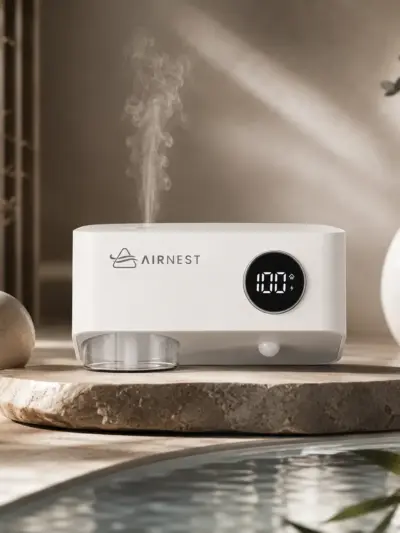
For air purifiers, treat UV-C as a “nice to have,” not a primary feature. For humidifiers, UV sterilisation is genuinely valuable. The Airnest Humidifier (UV-sterilised) uses UV specifically because the water-tank contact time is long enough for the technology to work.
DEHS aerosol (di-ethyl-hexyl-sebacate) is the test substance used in EN 1822 and ISO 29463 HEPA certification. A precise quantity of DEHS particles sized at the MPPS is generated upstream of the filter; a laser particle counter measures concentration downstream. The ratio gives the certified capture efficiency.
DEHS is non-toxic, oily, and produces particles in the exact size range that’s hardest for filters to catch. If a brand publishes EN 1822 test results, the test almost certainly used DEHS or DOP (a closely related test aerosol).
ULPA (Ultra-Low Penetration Air) is a higher-grade filtration standard above HEPA, capturing 99.999%+ of particles at 0.12 microns. Used in semiconductor cleanrooms, pharmaceutical manufacturing, and medical isolation. Not appropriate for residential use because of high airflow resistance.
For a home, ULPA is overkill. H13 already removes 99.95% of particles. The energy cost and motor noise to push air through ULPA media outweigh any practical air quality benefit in a residential setting. Brands that market ULPA to home consumers are stretching a real industrial standard into consumer marketing.
AHAM (Association of Home Appliance Manufacturers) is the US body that publishes the standard test protocol for CADR certification. AHAM Verifide certification on an air purifier indicates the product has been tested in a sealed chamber against three pollutants, smoke, dust, and pollen.
For Indian buyers, AHAM-certified CADR is the gold standard for cross-brand comparison. If two purifiers both publish AHAM smoke CADR numbers, you can compare them directly. If one quotes AHAM and the other quotes only “coverage area,” the latter is hiding something.
AHAM Verifide is the certification programme that publishes verified CADR test results for specific air purifier models. Manufacturers submit units for independent testing; verified results appear on the AHAM Verifide website. The seal on a product means the published CADR has been independently checked.
This is the strongest single signal of credible CADR claims. Brands that publish AHAM Verifide numbers are accepting third-party scrutiny of their performance claims; brands that don’t are asking buyers to trust the manufacturer’s self-reported data.
ASHRAE (American Society of Heating, Refrigerating and Air-Conditioning Engineers) publishes global ventilation and indoor air quality standards. ASHRAE Standard 62.1 sets the residential baseline at 4–5 ACH for indoor air. ASHRAE 52.2 publishes the MERV rating system for HVAC filters.
For Indian buyers, ASHRAE provides the global reference point. The “5 ACH” residential recommendation in this glossary and our CADR guide comes directly from ASHRAE 62.1. India has no equivalent national body for residential ventilation standards.
EN 1822 is the European standard for HEPA and ULPA filter classification, updated 2019. It defines grades E10–E12 (EPA), H11–H14 (HEPA), and U15–U17 (ULPA). Each filter is tested at MPPS, and the standard requires local leak testing of every H13-or-higher unit.
EN 1822 is the standard most reputable air purifier brands reference globally. Indian importers of European or East Asian filters typically inherit this certification. Look for “EN 1822” or the specific H-grade explicitly on the product page.
ISO 29463 is the international HEPA/ULPA filter standard published in 2017, the global successor to EN 1822. Performance thresholds are effectively identical to EN 1822, with slight differences in test methodology. Most modern HEPA certifications cite both standards.
For Indian buyers, EN 1822 and ISO 29463 are interchangeable signals of credible HEPA certification. If neither is mentioned, the “HEPA” claim is unsupported by any global standards body.
CPCB (Central Pollution Control Board) is the Indian government body responsible for air quality regulation and monitoring. CPCB publishes the National Air Quality Index dashboard used by weather apps and news services across India, and sets India’s national ambient air quality standards.
The Indian PM2.5 standard published by CPCB is 60 μg/m³ over 24 hours and 40 μg/m³ annually. Both are higher than WHO guidelines (15 μg/m³ daily, 5 μg/m³ annual), reflecting what India considers achievable rather than ideal.
WHO Air Quality Guidelines are the global health-based recommendations for pollutant exposure. The 2021 update set PM2.5 24-hour guideline at 15 μg/m³ and annual at 5 μg/m³. These are health-based targets, not feasibility-based standards, and are stricter than every country’s national regulation.
For Indian buyers, the WHO guidelines are the medical target to aim for, even if achieving them indoors requires active filtration year-round. Indoor PM2.5 below 15 μg/m³ during normal conditions is achievable in a sealed room with adequate H13 True HEPA capacity matched to room size.
BIS (Bureau of Indian Standards) is India’s national standards body, equivalent to ANSI in the US or DIN in Germany. BIS sets product safety and performance standards across categories, including consumer air purifiers via IS 17601.
For air purifiers specifically, BIS publishes the testing protocol but does not currently require manufacturers to disclose the specific HEPA grade (H11, H12, H13, H14) of their filter. This is the regulatory gap that lets “HEPA-type” filters be sold without consequence.
IS 17601 is the Indian Bureau of Standards specification for consumer air purifiers, published in 2021. It defines testing protocols for CADR, noise level, and energy consumption. It does not mandate a minimum HEPA grade for sale, which is the loophole that allows unregulated “HEPA-type” filters in the Indian market.
For now, Indian buyers should treat IS 17601 as a baseline that confirms basic safety and CADR claims, not as a guarantee of filtration quality. The HEPA grade still has to come from EN 1822 or ISO 29463 certification on top of IS 17601 compliance.
TERI (The Energy and Resources Institute) is an Indian research organisation that publishes peer-reviewed studies on indoor and outdoor air quality. TERI’s research is the most India-specific authority on indoor PM2.5 levels, cooking emissions, and seasonal pollution dynamics in Indian metro homes.
For Indian-specific air quality data, TERI is the most credible source after CPCB government data. Their research has documented kitchen PM2.5 spikes above 400 μg/m³ during heavy cooking, winter indoor PM2.5 in the 60–100 μg/m³ range, and the broader patterns referenced throughout our Hub 1 indoor air pillar.
National Building Code of India (NBC) is published by the Bureau of Indian Standards and governs construction, ventilation, and ceiling-height standards across Indian buildings. The typical residential ceiling height specified is 3 metres (about 10 feet), notably taller than US 8-foot or European 9-foot standards.
This matters for CADR calculations. Western CADR calculators assume 8–9 ft ceilings; Indian rooms are taller, which means you need 20–25% more CADR for the same air change rate. The 1.4 multiplier in our CADR guide corrects for India’s 10 ft ceiling.
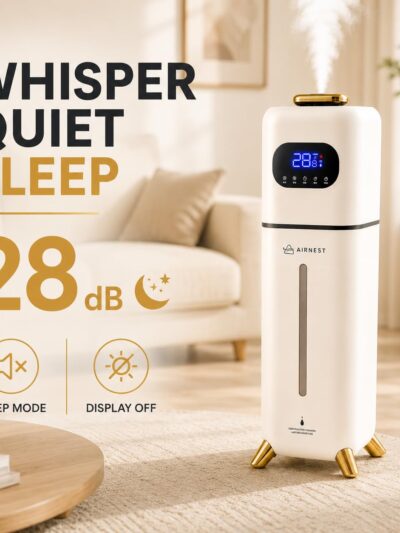
Sleep mode is a low-noise operating setting on an air purifier designed for overnight bedroom use. The standard threshold is ≤30 dB, quieter than a refrigerator and roughly equivalent to a whisper. Below this level, most users won’t register the sound during sleep.
A purifier with a loud sleep mode gets switched off after the third night, which means an off purifier cleaning no air. For comparison, the Core (₹4,999) runs at 24 dB on sleep mode and the Aura personal-space purifier at 22 dB. Look for a specific dB number, not vague “ultra-silent” claims.
Auto mode is a setting where an air purifier adjusts fan speed in real time based on a built-in air quality sensor. The purifier ramps up during cooking, smog spikes, or other pollution events and ramps down once the air is clean. This is the most useful single feature for Indian conditions where PM2.5 fluctuates rapidly.
Auto mode requires a real PM2.5 laser sensor in the purifier, not a generic dust sensor. Brands that publish CADR and HEPA specs but not their sensor technology often have basic dust counters rather than PM2.5-calibrated sensors. Ask the brand for the sensor specification.
Smoke CADR, Dust CADR, and Pollen CADR are the three separate CADR ratings published under AHAM certification. Each measures the purifier’s clean-air delivery rate against a different test particle size. Smoke particles are smallest (0.09–1 micron), dust is middle (0.5–3 microns), pollen is largest (5–11 microns).
For Indian buyers, smoke CADR is the most relevant of the three because it tracks closest to PM2.5. If a brand publishes only one CADR number without specifying which, assume it’s the highest of the three, typically pollen, which overstates real-world PM2.5 performance.
Coverage area is a brand claim about how large a room an air purifier can clean. Unlike CADR, coverage area is not standardised. Brands calculate it backward from CADR and a chosen ACH value. A 200 m³/h CADR can be marketed as “covers 500 sq. ft.” at 2 ACH (essentially useless) or “covers 140 sq. ft.” at 5 ACH (medically appropriate).
Always work backward from CADR and your desired ACH. Coverage claims hide ACH assumptions. For the formula and full breakdown, see our Indian CADR sizing math.
Filter lifespan is the typical operating duration of a HEPA or activated carbon filter before replacement is needed. In Indian conditions, H13 True HEPA filters typically last 6 to 12 months depending on pollution baseline, runtime hours, and whether the pre-filter is cleaned regularly. Heavy smog season use can shorten this to 5–7 months.
Filter replacement cost is one of the four core specs to check before buying, alongside CADR, HEPA grade, and noise. A cheap purifier with expensive filters can cost more over five years than a moderately priced one with reasonable filter pricing. See our buying guide for the five-year TCO worksheet.
dB (decibels) is the unit used to measure sound level. The relevant threshold for bedroom air purifiers is ≤30 dB on sleep mode, comparable to a whisper or rustling leaves. A refrigerator runs at 40 dB; a quiet conversation at 50 dB; an office at 60 dB.
Brand claims like “whisper-quiet” or “ultra-silent” without a specific dB number are not specifications. The actual dB rating should appear in the product spec table for each fan speed. The lowest setting (sleep mode) is what matters for bedroom placement.
CFM (Cubic Feet per Minute) and m³/h (cubic metres per hour) are the two units used to express CADR. CFM is standard in the US; m³/h is standard in Europe, Asia, and most Indian product spec sheets. The conversion: 1 CFM = 1.699 m³/h, or 1 m³/h = 0.589 CFM.
When reading US product reviews or AHAM data, convert CFM to m³/h before comparing with Indian spec sheets. The AHAM 2/3 rule for room sizing (CADR in CFM equals room sq. ft. × 0.67 for 5 ACH at 8 ft US ceiling) becomes m³/h = room sq. ft. × 1.4 for 5 ACH at India’s 10 ft ceiling.
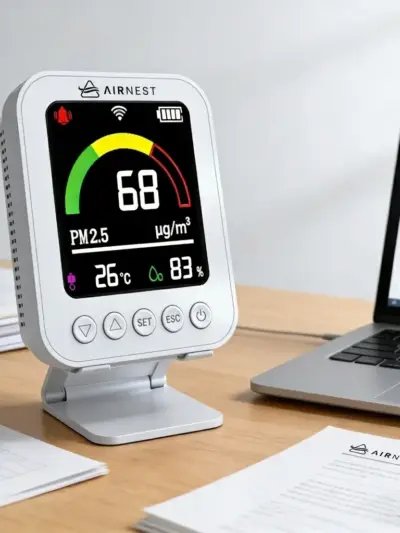
Indoor air quality monitor is a portable or fixed device that measures one or more indoor air pollutants in real time. The most useful monitors for Indian homes track four metrics: PM2.5, CO₂, temperature, and humidity. A monitor is the highest-leverage first purchase in any indoor air quality plan because it tells you what to actually fix.
The PM2.5 and CO₂ monitor from Airnest measures all four at ₹4,499, runs on a 3,200 mAh battery, and includes an 85 dB audible alarm when PM2.5 or CO₂ crosses unsafe thresholds. Three hours of measurement across kitchen, bedroom, and living room will tell you more about your indoor air than three months of guessing.
Different scenarios call for different terms. Quick orientation:
If you’re buying an air purifier: focus on CADR, HEPA grade, True HEPA, sleep mode dB, filter lifespan, and activated carbon filter. Ignore coverage area claims and verify AHAM Verifide where possible. Our air purifier buying guide walks through the 5-step decision flow.
If you’re sizing for a specific room: read CADR, ACH, National Building Code (for 10 ft Indian ceilings), and CFM and m³/h for unit conversion. Our CADR room size formula gives the worked examples.
If you’re measuring indoor air quality: focus on PM2.5, CO₂, ppm, μg/m³, and the Air Quality Monitor entry. The numbers in those entries tell you what’s normal, what’s bad, and what to act on.
If you’re trying to understand a “HEPA” label: read HEPA, True HEPA, HEPA-type / class / grade, H11–H14 grades, MPPS, EN 1822, and ISO 29463. Our True HEPA explainer goes deeper into the decoding.
If you’re learning about indoor pollution sources: focus on PM2.5, VOC, CO₂, NO₂, formaldehyde, dust mites, mould spores, and smog. Our six-source indoor pollution breakdown puts them in context.
This air quality glossary is a living document. New terms will be added as they appear in Airnest’s editorial content; existing definitions will be refreshed when standards update or new India-specific data emerges. If you’re working through a buying decision and a term you encounter isn’t here, that’s useful feedback.
For the buyer who wants the executive summary: ignore the marketing language (“HEPA-type,” “coverage area,” “ultra-silent”), look for the regulated terms (H13 True HEPA, AHAM-certified CADR, specific dB on sleep mode), and measure your actual indoor air before you buy anything (the Smart AQI Monitor at ₹4,499 is the right starting point). Knowing the vocabulary is the first half of making good air quality decisions. Acting on it is the second half.
For the natural next reads, our complete air purifier buying guide covers the decision framework, our Indian indoor air pollution complete guide covers the sources and health effects, and our best air purifier in India 2026 round-up covers specific model recommendations.
Clean air is a layered decision. This glossary is the vocabulary that makes the layers legible.
Pre-Order
Pre-Order